
If you have followed health news recently, you have probably heard about exciting new medications for diabetes and weight loss. You may have seen the brand names Mounjaro, Zepbound, Wegovy, or Retatrutide. These drugs have become very popular because they help people lose significant weight. But what is the science behind them? The answer lies in tiny chemical messengers in your gut called incretin hormones.
These natural hormones are produced by your body every time you eat. They act like a master communication system between your gut and your pancreas. They tell your body to release insulin, manage blood sugar, and even signal your brain that you are full. For decades, scientists knew these hormones existed. But only recently have they learned how to use them to help with weight management.
This article will explain what incretin hormones are, why they matter for your health, and how they work. We will focus on the two main types: GLP-1 and GIP. By understanding these natural hormones, you will better understand how new treatments work. This information will also prepare you for our future series articles, where we will go even deeper into this fascinating topic.
Key Takeaways
- Incretin hormones are natural messengers released by your gut after eating. They help control blood sugar and appetite.
- The two main incretin hormones are GLP-1 (glucagon-like peptide-1) and GIP (glucose-dependent insulinotropic polypeptide).
- GLP-1 slows digestion, helps your body release insulin when needed, and tells your brain you feel full.
- GIP also helps with insulin release and may work together with GLP-1 to improve metabolism.
- New medications that copy these hormones are very effective for weight management and type 2 diabetes.
- Lifestyle factors like diet and exercise can naturally affect your incretin levels.
What Are Incretin Hormones?
Let us start with a clear definition. Incretin hormones are a group of metabolic hormones. They are made of small chains of amino acids called peptides. Their main job is to lower blood glucose (blood sugar) levels after you eat.
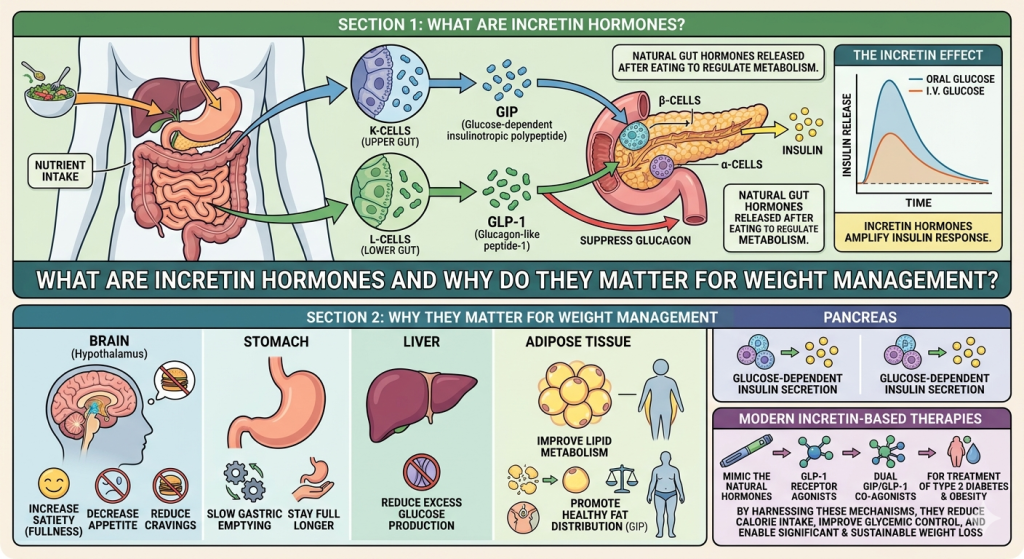
Here is how they work in simple terms. Imagine you eat a meal. As food enters your stomach and intestines, special cells in your gut wall detect the food. These cells then release incretin hormones into your blood. These hormones travel to your pancreas. Once there, they send a signal to your beta cells. These are the cells that make insulin. The incretin signal tells the beta cells to release insulin. This insulin then helps your body take sugar from your blood and use it for energy. This process prevents your blood sugar from getting too high after a meal.
Scientists call this the “incretin effect.” You can see this effect clearly in a simple experiment. If a person receives sugar through an IV (directly into a vein), their body releases some insulin. But if that same person eats or drinks the exact same amount of sugar, their body releases much more insulin. In fact, the insulin response can be two to three times higher! The difference is caused by incretin hormones released from the gut. The gut tells the pancreas, “Get ready! Sugar is coming!”
Two main incretin hormones do most of this work. They are called GLP-1 and GIP. Both are crucial for health.
However, these hormones do not last very long in your body. An enzyme called DPP-4 (dipeptidyl peptidase-4) breaks them down. Within a few minutes, GLP-1 and GIP are destroyed. This is why natural incretins have a short-lived effect. Scientists have had to get creative to use these hormones as medicines. They have developed drugs that either slow down the breaking process or are built to last much longer than the natural hormones. We will discuss these breakthroughs later.
For now, remember this main idea: Incretin hormones are natural gut messengers that control blood sugar and appetite.
The Two Main Types of Incretin Hormones
While there are other minor incretin-like substances, two main peptides rule the system. These are GLP-1 and GIP. Each one has a unique job and is made in a different part of your gut.
Let us explore each one in detail.
Glucagon-Like Peptide-1 (GLP-1)
GLP-1 stands for glucagon-like peptide-1. It is the star of the incretin world. Most of the recent weight loss and diabetes drugs are based on copying GLP-1.
Where is GLP-1 made?
GLP-1 is produced and secreted by special cells called L-cells. These L-cells are found in the lining of the lower part of your small intestine and your large intestine (the colon). When food reaches these lower parts of your gut, the L-cells release GLP-1 into your bloodstream.
What does GLP-1 do?
GLP-1 has several important jobs. They all work together to manage your metabolism.
- It increases insulin release. This is its primary job. When blood sugar rises, GLP-1 tells your pancreas to release more insulin. Importantly, it only does this when blood sugar is high. This means it has a low risk of causing dangerously low blood sugar (hypoglycemia).
- GLP-1 decreases glucagon release. Glucagon is another hormone made by your pancreas. Its job is to tell your liver to release stored sugar. This raises blood sugar. GLP-1 blocks this signal. By lowering glucagon, GLP-1 helps keep your blood sugar from getting too high.
- It slows gastric emptying. This is a fancy way of saying it slows down how fast your stomach pushes food into your small intestine. When food stays in your stomach longer, you feel full for a longer time. This also slows the speed at which sugar enters your blood, preventing big spikes.
- GLP-1 works on your brain. GLP-1 receptors are found in areas of your brain that control appetite, like the hypothalamus. When GLP-1 levels are high, it sends signals to your brain that reduce hunger and increase feelings of fullness (satiety).
- It may improve heart health. Some studies suggest GLP-1 can have positive effects on blood pressure, cholesterol levels, and inflammation in blood vessels.
How is GLP-1 used in medicine?
Natural GLP-1 breaks down in minutes. So, scientists created drugs called GLP-1 receptor agonists. These drugs mimic natural GLP-1 but are resistant to the DPP-4 enzyme. They last much longer in the body. Some are injected once a day, and others once a week. Examples include:
- Exenatide (Byetta, Bydureon) – The first of its kind, approved by the FDA in 2005 for type 2 diabetes.
- Liraglutide (Victoza for diabetes, Saxenda for weight management)
- Semaglutide (Ozempic for diabetes, Wegovy for weight management) – Approved for diabetes in 2017 and for obesity in 2021. It is now one of the most prescribed drugs in the United States.
These drugs have been shown to cause significant weight loss, often 10-15% of total body weight. They work by reducing appetite, slowing digestion, and changing food preferences. Many people find they simply do not think about food as much while taking these medications.
Glucose-dependent Insulinotropic Polypeptide (GIP)
GIP stands for glucose-dependent insulinotropic polypeptide. It used to be called “gastric inhibitory peptide” because scientists thought its main job was to slow stomach acid. But we now know its main role is much different. GIP is the second major incretin hormone.
Where is GIP made?
GIP is produced and secreted by K-cells. These K-cells are located in the lining of the upper small intestine, specifically the duodenum (the first part) and the upper jejunum (the second part). Because these cells are higher up in the gut, GIP is released earlier in the digestive process than GLP-1.
What does GIP do?
For a long time, GIP was considered less important than GLP-1. But new research has changed this. Here is what GIP does.
- It increases insulin release. Like GLP-1, GIP signals the pancreas to release insulin when blood sugar is high. This is its primary role.
- GIP’s effect on appetite is complex. Early studies showed GIP had little effect on appetite. But newer research shows that GIP may actually work with GLP-1 to improve metabolism. In some cases, GIP might help the body become more sensitive to insulin. It may also affect fat storage and how your body uses fat for energy.
- It may affect bone health. Some evidence suggests GIP plays a role in building and breaking down bone tissue. This is an area of active research.
- GIP is less likely to cause nausea. GLP-1 drugs often cause nausea, especially when starting them. GIP does not seem to cause this side effect. This is important because combining GLP-1 and GIP actions may allow for better results with fewer side effects.
Why did scientists ignore GIP for so long?
Here is the problem. In people with type 2 diabetes, the insulin-releasing effect of GIP is very weak. Scientists thought this meant GIP was not useful. But now we know that high blood sugar levels and long-term diabetes “break” the GIP system. The receptors become less sensitive. However, when blood sugar is brought back to normal, the GIP effect returns. Also, GIP seems to work much better when combined with GLP-1.
How is GIP used in medicine?
For a long time, no drugs targeted GIP alone. That changed in 2022. The FDA approved a drug called Tirzepatide (Mounjaro for diabetes, Zepbound for weight management). Tirzepatide is not just a GLP-1 drug. It is a dual agonist. This means it activates both the GLP-1 receptor and the GIP receptor. It is a GIP analog with strong activity on both receptors.
Tirzepatide has been shown to cause even greater weight loss than semaglutide alone. In clinical trials, some people lost 20-25% of their body weight. This suggests that combining GLP-1 and GIP actions is more powerful than targeting either one alone. The GIP part may help improve metabolism while reducing the nausea sometimes caused by GLP-1 drugs.
How Gut Bacteria Affect Incretin Hormones?
This is an additional section that is important for a general wellness audience. Your gut health may affect your natural incretin levels. The Wikipedia article on incretins notes that short-chain fatty acids (SCFAs) play a role. Where do these SCFAs come from? They come from your gut microbiome.
The bacteria living in your large intestine ferment fiber from your diet. This fermentation process produces SCFAs, primarily acetic acid, propionic acid, and butyric acid. These SCFAs then bind to special receptors (called FFAR2 and FFAR3) on both K-cells and L-cells. This binding stimulates the production and release of GIP (from K-cells) and GLP-1 (from L-cells).
What does this mean for you?
A diet rich in fiber from vegetables, fruits, beans, and whole grains feeds your good gut bacteria. These bacteria then produce SCFAs, which may naturally boost your incretin levels. This is one reason why a high-fiber diet is helpful for weight management and blood sugar control. It supports the natural release of your body’s own GLP-1 and GIP.
Why Do Incretins Matter for Weight Management?
Now, let us tie everything together. Why should you, a general wellness reader, care about incretins? Here are three main reasons.
Reason 1: They are the basis for powerful new weight loss drugs.
Understanding GLP-1 and GIP has led to a revolution in obesity medicine. For decades, there were few safe and effective weight loss drugs. Now, GLP-1 agonists and dual GLP-1/GIP agonists offer a way to lose a significant amount of weight. They do not require willpower alone to fight hunger signals. Instead, they change the biology of appetite. For many people with obesity or overweight-related health problems, these drugs are life-changing.
Reason 2: They explain why “diet and exercise” advice is not enough for everyone.
For a long time, people with obesity were told to simply “eat less and move more.” But we now know that appetite is controlled by powerful hormones like GLP-1 and GIP. Some people may naturally have lower levels or weaker responses to these hormones. This is not a personal failing. It is biology. Understanding incretins helps reduce the stigma around obesity. It shows that weight management is not just about willpower.
Reason 3: You can support your natural incretin system.
Even if you never take a medication, you can take steps to help your body release more GLP-1 and GIP naturally. Here are a few science-backed strategies.
- Eat more fiber. As discussed, fiber leads to SCFAs, which stimulate GLP-1 and GIP release. Aim for 25-35 grams of fiber per day from whole plant foods.
- Include protein at every meal. Protein is a strong trigger for incretin release. Whey protein, in particular, has been shown to significantly increase GLP-1 levels.
- Consume healthy fats. Fats from nuts, seeds, avocados, and olive oil also trigger incretin release, especially GIP.
- Try fermented foods. Yogurt, kefir, kimchi, and sauerkraut contain probiotics. A healthy gut microbiome is better at producing SCFAs that boost incretins.
- Eat smaller, more frequent meals. Large meals can sometimes overwhelm the incretin system. Smaller meals may lead to more sustained GLP-1 release.
- Exercise regularly. Both aerobic exercise (walking, running) and resistance training (weight lifting) have been shown to improve the body’s sensitivity to incretins and may increase GLP-1 levels over time.
What’s Next? A Bridge to Our Series
This article has covered the foundational concepts of incretin hormones. You now know what GLP-1 and GIP are, where they come from, and what they do. You understand why they matter for both diabetes and weight management.
But there is much more to learn. In our upcoming series, we will dive deeper into specific topics. We will explore the differences between the various GLP-1 drugs. We will look at the real-world results of tirzepatide. We will discuss the side effects and who is a good candidate for these medications. We will also examine the role of the third incretin, GLP-2, and other gut hormones like PYY.
The science of incretins is moving very fast. New drugs that target triple receptors (GLP-1, GIP, and glucagon) are already in development. These next-generation drugs may be even more powerful for weight loss. They might also have benefits for liver disease and other conditions.
By understanding the basics in this article, you are now prepared to understand those deeper discussions. The era of gut hormone-based medicine has arrived. Whether you choose to use these medications or simply want to optimize your natural incretins, this knowledge empowers you to take control of your metabolic health.
Conclusion
Incretin hormones—GLP-1 and GIP—are essential messengers in your body. They connect your gut, pancreas, and brain to manage blood sugar and appetite. For decades, they were a scientific curiosity. Now, they are the basis for a new class of highly effective drugs for type 2 diabetes and obesity.
Understanding incretins helps explain why eating triggers insulin release. It explains why some people feel full quickly while others do not. And it opens the door to new treatments that work with your body’s own biology. You can support your natural incretin system with a high-fiber, protein-rich diet and regular exercise. And for those who need more help, GLP-1 and dual GIP/GLP-1 agonist drugs offer a powerful, science-based option.
The future of weight management is closely tied to these remarkable gut hormones. Stay tuned for our next article, where we will put these concepts into real-world action.
